The Unfriendly Man
Finishing my morning run, I jogged down the hill and out of the woods. Gerry met me in front of our trailer. “We should to stay within sight and hearing awhile,”he said, “we’ve got a strange acting man over there. Just came in.” He nodded toward a rusty El Camino parked at a campsite.
There were no other campers.
“How is he strange?” I asked.
“When I tried to talk to him, he mumbled something. Seemed surly. Then he turned and walked down to the river. There! To the right. He’s coming back.” The man who emerged from the trees walked with an attitude. He wore a blue shirt, slightly threadbare, loose white pants, and thong sandals. Hunching his shoulders, he passed by, and ignored us. I spoke. No answer. No eye contact. He’d tilted his hat to cover his eyes. It was a straw hat with a red bandana hanging loose around the edges.
“I’m calling the ranger station,” Gerry said. He went into the trailer. I stayed to observe the man. A gust of wind whipped his baggy pants around his legs and flattened his shirt against his chest and arms. At this distance and from the side, he resembled a stick figure drawing all sharp knees and elbows. He entered his truck, turned his back to me, head down, shoulders pulled forward. I read the gesture. It said, “Leave me alone.”
I remembered that some of the rangers carried guns. “Anything can happen in a campground,” they’d told us. “Odd people show up sometimes. Not ordinary campers.” We’d just met one. Gerry had given the ranger on duty the man’s liscense number. After he’d traced it, the ranger called back. “Your man’s been here before.” he told us. “He’s harmless but he lacks social skills.”
So now he was a man. I didn’t really want him. Gerry and I volunteered as hosts for the National ParkService on the Buffalo River in Arkansas. It was Monday. Before the El Camino rattled in, no other visitors remained in the campground…no loud voices, no gut thudding rock music, no dusty rumble of car traffic. Just the soughing of a high, thin wind with gusts and lots of unpeopled space.
We had a routine for greeting campers. We’d introduce ourselves, write down the license number, ask how many people were in the party and what they planned to do in the area, list the campground rules, and explain that we help campers. Campground hosts become extra eyes and ears for the rangers. We also fill another role. Adults away from home sometimes need parent substitutes.
In two months, we’d offered hot coffee and our coats to folks wet and cold from bad weather or clumsy float trips. We’d jump started cars, recharged camera batteries, and adjusted the seat on a woman’s bicycle. We also waved a lot. Whenever people left to roam, we waved goodbye. When they returned, we waved again. Most waved back. A few stopped to talk. When someone has met an elk in the woods or found a toad in his sleeping bag, it’stoo good to keep to himself. If folks have crashed their canoes, endured a storm in a leaking tent, or had their socks stolen by a stray dog, it becomes an adventure when shared. On the whole, people love to communicate.
But not everybody.
Other folks came and went. Our man stayed. For a week he seldom left his truck day or night. He remained out of sight or turned his back when we patrolled. We spoke. No response. “Good morning” must have been erased from his vocabulary. If he’d ever owned a smile, he’d lost it. We, however, exuded cheer. Lilting “hello’s.” Smiles. Lots of teeth. I think we hoped to vibrate him friendly.
During the second week, he’d sometimes leave for hours. He also began to sit cross legged on a picnic table style, eyes closed, chanting. He usually assumed this stance when someone approached him. It was an effective way to shut intruders out of his space and, since Gerry and I were the most insidious intruders, we backed off. This led to a relationship that worked. He pretended not to see us; we pretended not to see him.
One morning, I met him near the pavilion. When he gazed right past me,a grin stretched across my mind at the absurdity of it all. I felt a mischievous urge to pray a mischievous prayer, “Let something good happen to cheer this man, ” I thought, “and let something funny make him want to laugh out loud.” I knew he wouldn’t laugh. Someone might think him approachable and approach him. So I pictured him trying to hide uncontrollable mirth behind his hat. I imagined his grim expression breaking into soft folds of hilarity. I chuckled, enjoying the image.
That night, the situation shifted.
Around 8:30, he knocked at our door. Gerry and I stood speechless; we assumed we were now visible and didn’t know how to act. We let him speak first. “My car,” he said in a soft, hesitant voice. ” Ran it into a ditch up the road to miss a deer. Got it stuck. Had to leave it.”
Gerry glanced back at me and raised his eyebrows before answering, “We’ll be glad to help.” he said, ” What do you need?”
“You got a can opener? I carried my tent out of the car and things for the night, but I got this can of beans for supper. I need to open it.” And he did. Right at the door.
Next day, he dropped by to let us know that he’d arranged for his car to be repaired and that his name was Ben. Nothing more. Circumstance had forced him to acknowledge us but he still wasn’t a detail man.
Comparing observations, Gerry and I realized that we already knew a few things about Ben. He washed and shaved in the campground rest room but his clothes were frayed, shy a few buttons, and stained.(No sewing or laundry skills?) He didn’t litter and he extinguished his campfires carefully. He read several books, dogs liked him, and he was bald. His age? Forty five, maybe fifty.
We soon realized that our can opener had opened more than beans. It opened a narrow window marked mutual greetings where Ben offered a curt nod every morning, Gerry said, “Isn’t it a fantastic day?!” Loud voice. Exclamation point! And I smiled. It also opened up our acceptance of what made Ben unique and interesting, his hat, bandanna, baggy clothes, bouts of yoga, and the neighborhood basset hound that visited him daily howling like emergency 911. We learned to respect his solitary ways and, without knowing when it happened, we began to worry about him. Mostly, we worried that his food supply was low. One day, we gathered up enough audacity to offer him a ham sandwich. He said he didn’t eat meat.
Later, on our way to the grocery, we invited him to ride along. He said he’d rather not. “But,” he added, “you could buy a few things for me. I’d give you the money. That way you won’t spend more than I can pay back.” When we agreed, he handed me $1.50 and said that he wanted two carrots and as many jonathan apples as the money would cover. The burden of it hit my chest and shoulders. I wanted the most for his money. No brown spots on the apples. No gnarled carrots. I needed divine inspiration for this, I decided as I entered the local supermarket. Then I lost my faith and nearly panicked when I couldn’t find any loose carrots. Faith returned when I discovered that packaged carrots were on sale at five for a dollar. I selected a bag, poking and prying each carrot into view to assure myself that it was slim, straight, and not limp. The apples were seventy nine cents a pound. I weighed apple after apple searching for the best, muttering to myself, “How’s this one? How’s that one?” choosing at last three. Crisp, red, and firm. The bill came to $I.26. I could give Ben change. I’ve seldom felt so absurdly pleased with myself or so humble, as if I were standing on Holy Ground and should remove my shoes.
Ben’s quality of life probably wasn’t changed much by those few groceries but when he accepted the bag, he almost smiled. Then having turned away, he turned back and said, “Um I a thank you.” Social skills! I felt as if he’d given me a gift.
Later, Gerry and I talked. We sorted and shared impressions, culling and refining them down to these conclusions: that sacred moments can happen in the unlikeliest places(in that supermarket an ordinary bag of carrots and three apples took on glory, felt like gladness); that the wish to help someone has value even when we’re awkward at it. (Gerry and I lurched about with handfuls of good intentions, fumbling and dropping cues, almost missing the mark); that compassion doesn’t happen through one sizeªfits all good deeds(we achieved more when we allowed Ben to be himself, helping him in ways he could accept).
This story has no big ending. Gerry and I left the campground briefly the next morning. When we returned, Ben had put a note on our door. His car was finished, a ranger had taken him to pick it up, some money had arrived that he’d been expecting, and he was moving on.
Ben had said “goodbye”… and he’d included details.
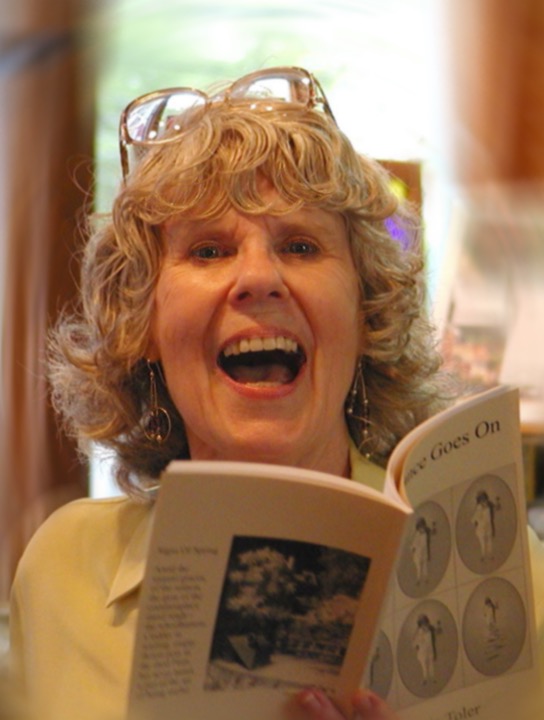
Author: Rosalie Toler
Rosalie Toler; writer of humor, religion, nature, and letters and a gifted speaker of motivational programs. She also wrote many essays on her subjects of humor and religion with those published in magazines and newspapers. She developed into a writer of poetry and self-published two collections of that work.
Rosalie was a summa cum laude graduate from Southwest Missouri State University with a degree in English and Religion.